When a Roman Catholic scholar involved in the Dead Sea Scrolls Project discovers a heretical message contained in one of the Scrolls he hides it. Decades later, a prominent archeologist discovers reference to the scroll in an archeological dig. This discovery spurs the world religions into a dangerous game of cat and mouse, in which all who seek the hidden scroll are mysteriously silenced, leaving the salvation of humankind to a father and son, who must either find the hidden scroll … or die trying.
___________________________________________________________________________________________________________________
Showing posts with label Pottery Artifacts. Show all posts

Pottery Artifacts: Sundial from Qumran


A sundial found at Qumran thought to have been used to determine the cosmic calendar for the celebration of the Jewish feasts.


Pottery Artifacts from the Qumran Site


Pottery First century B.C.E.-first century C.E.
Courtesy of the Israel Antiquities Authority

During the excavation of the Qumran ruin, these V-shaped drinking goblets were found stacked in what had been a storeroom.

The quality of their construction and craftsmanship leads some contemporary archaeologists to argue that the site was a Roman villa, because the presence of vessels of this quality would not be in keeping with the austerity of an ascetic community.

Pottery Artifacts from the Qumran Site

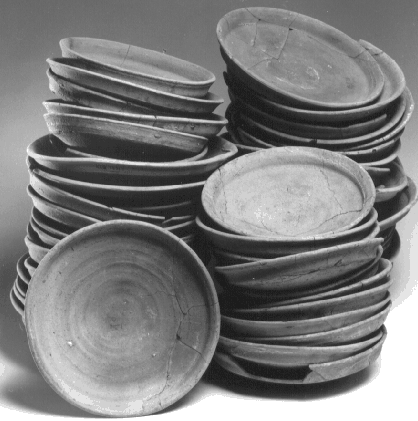
Plates, bowls, and goblets were found in one of the rooms at Qumran, with dozens of vessels piled one on top of the other. This room probably served as a "crockery" (storage area) near the assembly room, which may have functioned as the dining room. 


 Pottery First century B.C.E.-first century C.E. Courtesy of the Israel Antiquities Authority

These fifteen, wheel-made plates are shallow, with a ring base and upright rim. The firing is metallic. Hundreds of plates were recovered, most of them complete, some with traces of soot.

Pottery Artifacts from the Qumran Site


This type of lamp was found in strata associated with Herod's reign (37-4 B.C.E.). A similar lamp was uncovered in the Jewish Quarter of Jerusalem, in strata dating to the destruction of the Second Temple (70 C.E.), thus raising questions as to the date of the lamp.

Characteristic features of this lamp type are a circular wheel-made body, a flat unmarked base, and a large central filling hole. The spatulate nozzle was hand-built separately and later attached to the body. Traces of a palm-fiber wick were found in the lamp's nozzle.


Pottery with fiber wick First century B.C.E.-first century C.E.

Pottery Artifacts from the Qumran Site

Locating pottery, coins, and written material at an archaeological site establishes a relative and an absolute chronological framework for a particular culture. Pottery vessels found in the immediate area of Qumran and items from the surrounding caves and cliff openings are identical. The area seems to have been a regional center and most likely was supplied by a single pottery workshop.


This elongated barrel-shaped jar has a ring base, a ribbed body, a very short wide neck, and two loop handles. The vessel was probably used to store provisions.